

BRI hosts international exchange
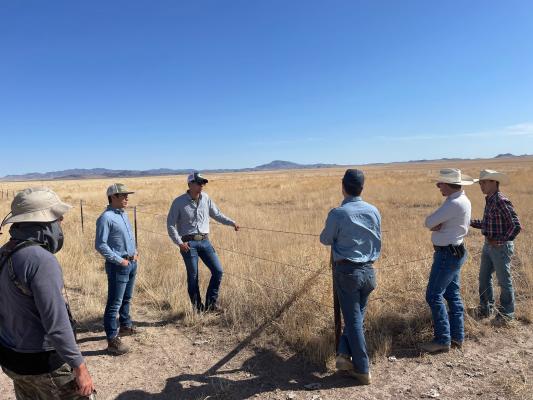
The Borderlands Research Institute, housed at Sul Ross State University, hosted students from the Autonomous University of Chihuahua, a Mexican public university located in Chihuahua City, Chihuahua, Mexico. Students from the Animal Science and Ecology programs at UACH learned about BRI research projects along with other regional conservation initiatives.
So far, three groups of six students each have participated, with one more group planned for this summer. The exchange was funded through a grant from 100,000 Strong in the Americas Innovation Fund and its partners, the U.S. Department of State, Fundación Banorte, and Fundación Gruma, as part of the public-private sector collaboration between the Bureau of Western Hemisphere Affairs at the U.S. Department of State and Partners of the Americas.
The grant paid for meals, lodging, and student travel within the region. It also provided the students with some supplies, including backpacks and binoculars.
The students stayed in Alpine for six nights, and visited all of the ecoregions represented in the Big Bend. In addition, they toured Sul Ross and the Alpine downtown district.
Although only separated by about 240 miles and a four-hour drive, this marked the first time the two departments have collaborated this way.
Both schools are situated within the Chihuahuan Desert, which encompasses roughly 200,000 square miles of the American Southwest and northern Mexico. It is regarded as the most biologically diverse desert in the Western Hemisphere.
The universities are ripe for collaborative research and academic kinship, something professors from both colleges are looking for ways to continue.
BRI’s Nau Endowed Professor in Habitat Research and Management, Dr. Carlos E. Gonzalez, said the exchange benefits programs on both sides of the river.
“It’s an opportunity to showcase our different challenges, different laws, and the differences in how people apply resource management. But at the end of the day, we have the same goal—to sustainably manage resources over long periods of time,” Gonzalez said.
- Log in or Subscribe to post comments.
